
£199.76 – £1,439.65Price range: £199.76 through £1,439.65
Technical Assessment
Sterling Silver “H” Ring
1. Overall Design
The silver “H” ring is a contemporary statement jewellery piece characterised by a bold geometric profile and minimalist architectural styling. The design prioritises clean lines, substantial proportions, and a highly polished metallic finish, creating a piece that functions equally as fashion jewellery and everyday luxury jewellery.
Strengths:
Unlike traditional dress rings, the emphasis is placed upon mass, geometry, and modern industrial aesthetics.
⸻
2. Metal Construction
Typical materials:
Composition of 925 Sterling Silver:
Characteristics:
The addition of alloying metals significantly improves strength compared with pure silver while maintaining the appearance associated with precious metals.
⸻
3. Rhodium Plating
Most premium silver “H” rings receive a rhodium-plated finish.
Rhodium characteristics:
Benefits:
⸻
4. Manufacturing Technology
Modern examples typically utilise:
Strengths:
⸻
5. Surface Engineering
Common finishes include:
Characteristics:
⸻
6. Ergonomics
Typical characteristics:
Strengths:
Despite its substantial appearance, most examples are engineered for practical everyday use.
⸻
7. Structural Characteristics
Modern rings commonly feature:
Strengths:
⸻
8. Stone Variants
Although plain polished versions are common, alternative versions may include:
Typical setting methods:
The underlying ring construction generally remains unchanged.
⸻
9. Durability
925 sterling silver provides:
Primary wear points:
The base silver itself is highly durable and can usually be professionally polished if surface wear develops.
⸻
10. Commercial Classification
This type of ring is generally classified as:
Where no protected branding or trademarks are applied, it is simply a modern jewellery design rather than a counterfeit product.
⸻
11. Manufacturing Quality
Modern production typically includes:
Strengths:
⸻
12. Ownership Characteristics
The appeal of the silver “H” ring is derived from:
Its value lies in material quality, manufacturing precision, and contemporary design rather than complex mechanical or gemstone engineering.
⸻
Technical Strength Summary
Strongest Areas:
⸻
Executive Summary
The AAA Sterling Silver “H” Ring is a contemporary luxury-inspired statement ring manufactured primarily from 925 sterling silver and typically finished with a rhodium-plated surface to improve brightness, tarnish resistance, and long-term durability. Modern manufacturing methods—including CAD design, CNC machining, precision casting, multi-stage polishing, and quality-control inspection—produce a ring with accurate geometry, robust construction, and a refined mirror finish.
The ring’s principal strengths lie in its premium precious-metal composition, precision engineering, ergonomic comfort, and bold architectural styling. While mechanically simple, it demonstrates a high standard of modern jewellery manufacturing through its consistent production quality, corrosion-resistant materials, and durable finish. The result is a substantial everyday jewellery piece that combines practical wearability with a contemporary luxury aesthetic and strong visual presence.
Technical Assessment
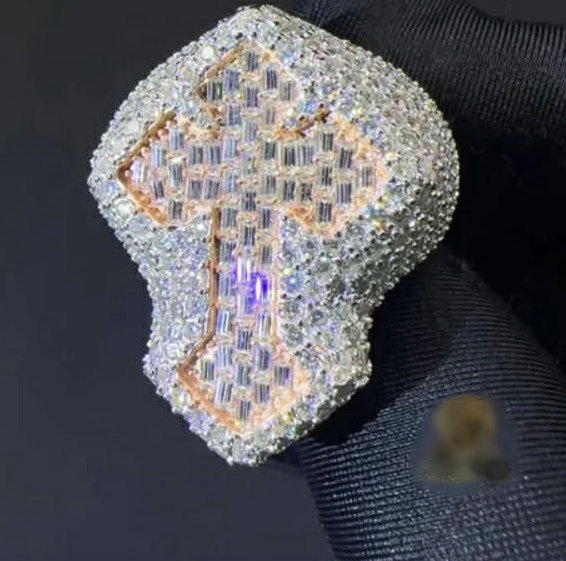
Moissanite Chrome Hearts-Style Ring
1. Overall Design
The ring uses the distinctive Gothic aesthetic associated with Chrome Hearts-inspired jewellery:
The design is intended as a statement jewellery piece rather than a traditional dress ring.
⸻
2. Construction
Typical materials:
Characteristics:
⸻
3. Gemstone Specification
Commonly fitted with:
Premium examples generally use laboratory-grown moissanite.
⸻
4. Moissanite Material Science
Chemical Formula:
SiC – Silicon Carbide
Composition:
Properties:
The stones produce significantly more rainbow fire than natural diamond.
⸻
5. Stone Setting
The image appears to incorporate multiple setting styles:
This combination creates contrast between sparkle and geometric structure.
⸻
6. Manufacturing
Modern examples typically involve:
⸻
7. Durability
Primary wear points:
Moissanite itself is extremely resistant to:
⸻
8. Commercial Classification
If sold without unauthorised branding, it is best described as:
If it bears protected Chrome Hearts trademarks or logos without authorisation and is marketed as genuine Chrome Hearts, it would generally be considered counterfeit merchandise.
⸻
Technical Strength Summary
Strongest Areas:
⸻
| Chrome H rings | Silver With box, yellow gold With box |
|---|
Reviews
There are no reviews yet.