
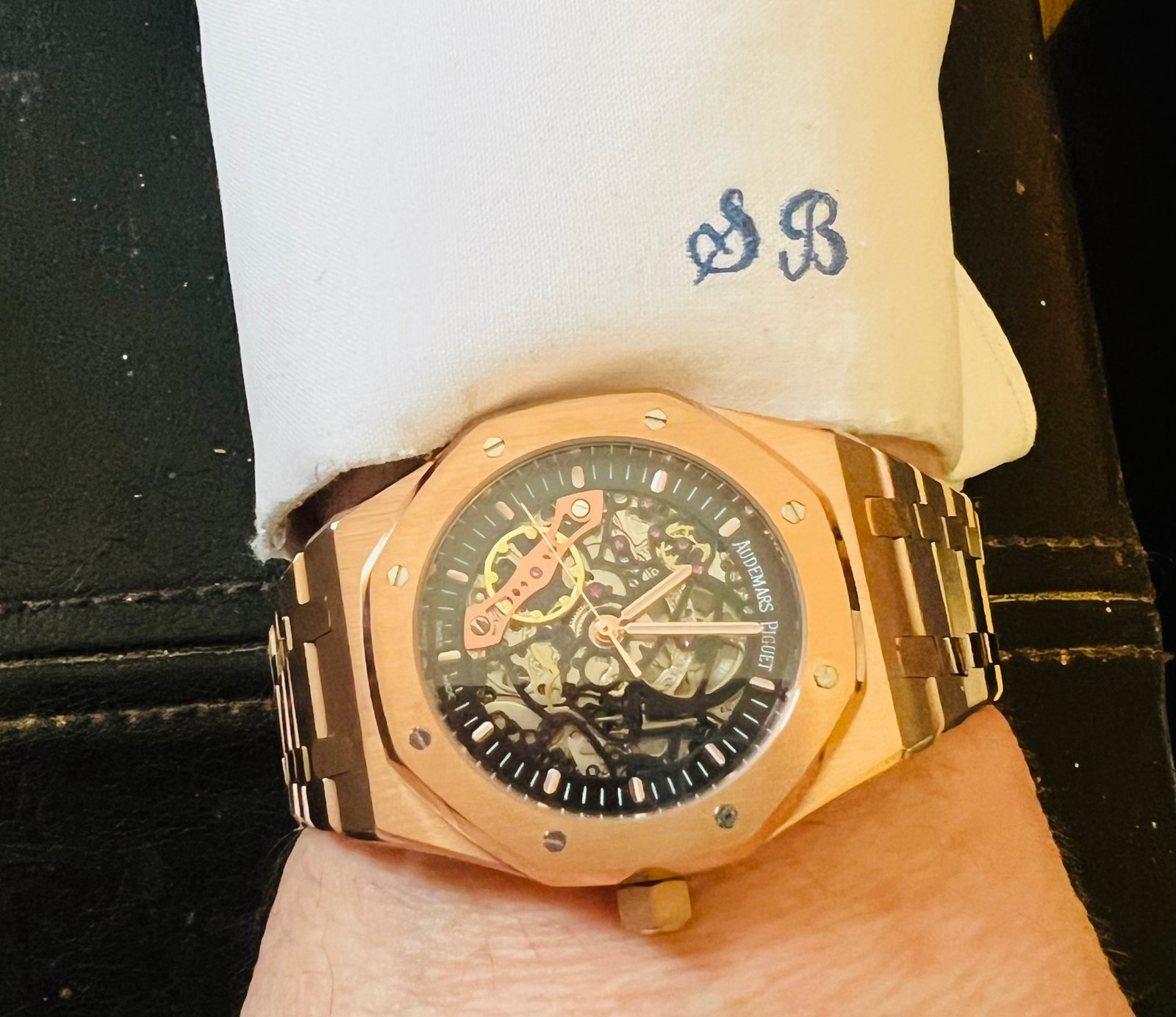

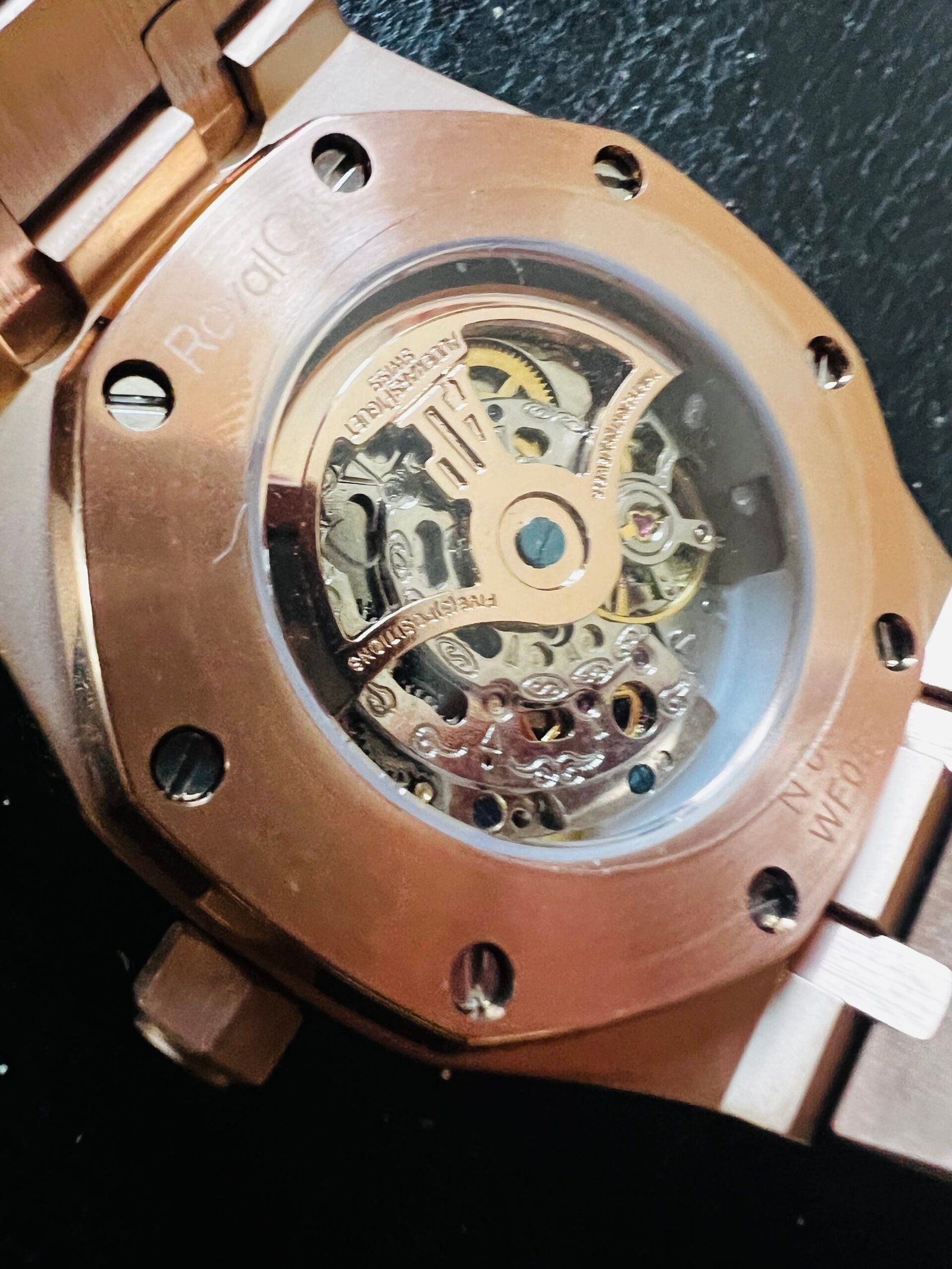
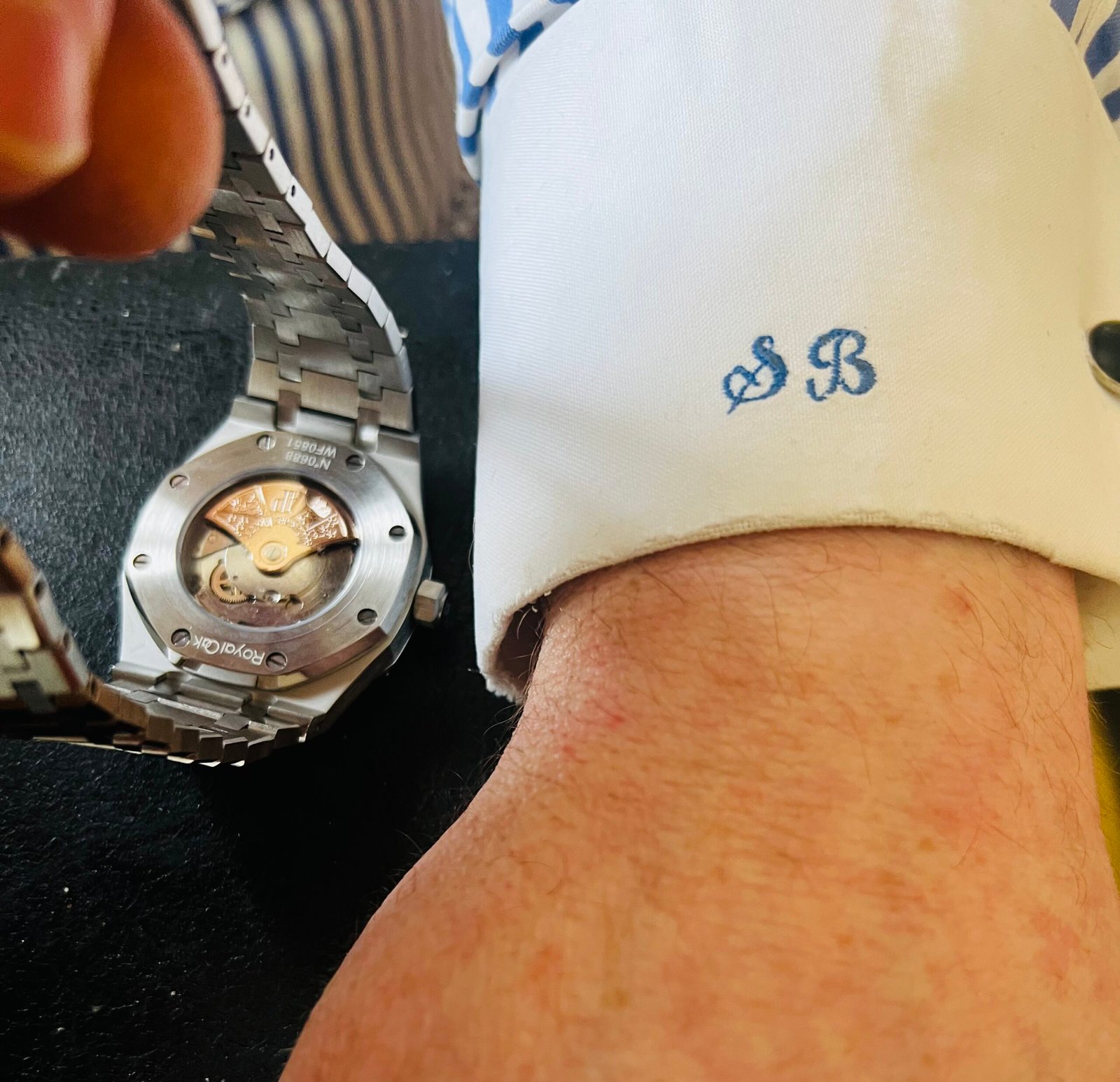



AP Royal Oak Superclone

Original price was: £999.99.Current price is: £599.99.


Audemars Piguet Royal Oak Super Clone

Core Functions & Features Summary

Movement

  • Dedicated clone AP movement (3120, 4302, or 4401 depending on model).
  • Correct bridge architecture.
  • Correct rotor layout.
  • Similar beat rate to genuine movement.
  • Automatic winding system.
  • Date complication where applicable.
  • Power reserve broadly comparable to genuine design.

Case

  • CNC-machined stainless-steel construction.
  • Reverse-engineered dimensions from genuine watches.
  • Accurate case thickness.
  • Accurate bezel profile.
  • Correct lug geometry.

Metallurgy

  • High-grade 316L stainless steel.
  • Corrosion-resistant alloy.
  • Similar density to genuine AP steel models.
  • Suitable for brushing and polishing.

Bezel

  • Octagonal Royal Oak bezel.
  • Correct screw positioning.
  • Correct screw depth.
  • Accurate edge geometry.
  • Multi-stage finishing process.

Bracelet

  • Fully integrated Royal Oak bracelet.
  • Articulated link construction.
  • Accurate taper profile.
  • Improved clasp mechanism.
  • Weight distribution close to genuine specifications.

Dial

  • Grande Tapisserie pattern replication.
  • Applied hour markers.
  • Applied AP logo.
  • Luminous markers and hands.
  • Improved font accuracy.
  • Colour matching to genuine references.

Crystal

  • Sapphire crystal.
  • Scratch-resistant surface.
  • Anti-reflective coating.
  • Correct crystal thickness.

Finishing

  • Brushed surfaces.
  • Polished bevels.
  • Sharp edge transitions.
  • Multi-directional finishing patterns.
  • Improved consistency compared with earlier generations.

Weight & Dimensions

  • Close-to-genuine weight.
  • Accurate diameter.
  • Accurate thickness.
  • Accurate bracelet proportions.

Manufacturing

  • Multi-axis CNC machining.
  • CAD/CAM design.
  • Digital metrology and measurement.
  • Reverse engineering from genuine watches.
  • Specialist component supply chain.

Quality Control

  • Better assembly tolerances.
  • Improved movement regulation.
  • Consistent case finishing.
  • Improved bracelet fitment.

The Five Most Important Technical Achievements

  1. Clone AP movement architecture.
  2. Accurate Royal Oak case geometry.
  3. Accurate integrated bracelet construction.
  4. Correct octagonal bezel engineering.
  5. High-quality brushed and polished finishing.


Description

AUDEMARS PIGUET SUPER CLONE

Technical Assessment of Modern Royal Oak Super Clones

Executive Summary

Modern Audemars Piguet super clones represent one of the most sophisticated products produced by the contemporary Chinese watch-replication industry.

Unlike Rolex replication, which is heavily movement-centric, AP replication is primarily a manufacturing, machining, and finishing challenge. The Royal Oak’s integrated bracelet, octagonal bezel, ultra-sharp bevel transitions, and complex brushed surfaces require substantially greater production precision than most traditional sports watches.

The industry’s advancement has been driven by high-resolution metrology, multi-axis CNC machining, dedicated clone calibres, specialist component factories, and improved quality-control systems.

1. Movement Architecture

Clone 3120

Replicates:

  • AP Calibre 3120

Common Models:

  • Royal Oak 15300
  • Royal Oak 15400
  • Royal Oak 15450

Characteristics:

  • Correct bridge architecture.
  • Correct rotor layout.
  • Similar beat rate.
  • Similar visual appearance through caseback.

Clone 4302

Replicates:

  • AP Calibre 4302

Common Models:

  • Royal Oak 15500
  • Royal Oak 15510

Characteristics:

  • Improved architecture accuracy.
  • Improved power reserve.
  • Better finishing quality.
  • More accurate dimensions.

Clone 4401

Replicates:

  • AP Calibre 4401

Common Models:

  • Royal Oak Chronograph

Characteristics:

  • Integrated chronograph architecture.
  • Complex gear train replication.
  • Correct visual layout.

Movement Assessment

Key strengths:

  • Visual similarity.
  • Correct architecture.
  • Accurate rotor placement.
  • Similar operating characteristics.

Primary limitations:

  • Finishing quality.
  • Long-term durability.
  • Manufacturing tolerances.
  • Service support.

2. Metallurgical Analysis

Material

Most high-end AP super clones utilise:

  • High-grade 316L stainless steel.

Reason:

  • Genuine AP Royal Oaks also utilise 316L steel.
  • No requirement to mimic Rolex-style 904L alloys.

Metallurgical Characteristics

  • Excellent corrosion resistance.
  • Good polishing characteristics.
  • Good brushing response.
  • Stable machining performance.

Practical Assessment

The primary differentiator is not alloy composition.

The primary differentiator is the quality of:

  • Machining.
  • Surface preparation.
  • Brushing.
  • Polishing.
  • Final finishing.

3. Case Manufacturing

Production Method

Modern AP super clones typically employ:

  • Multi-axis CNC machining.
  • CAD-based reverse engineering.
  • Digital metrology.

Key Achievements

  • Accurate case thickness.
  • Accurate bezel dimensions.
  • Accurate lug geometry.
  • Correct case profile.

Technical Challenge

The Royal Oak contains numerous intersecting geometric surfaces requiring precise machining.

This is one of the most difficult luxury-watch cases to manufacture accurately.

4. Engineering

Octagonal Bezel System

The Royal Oak bezel contains:

  • Eight visible hexagonal fasteners.
  • Complex bevel geometry.
  • Multiple finishing transitions.

Super Clone and Swiss Clone Performance

Modern examples typically achieve:

  • Accurate bezel dimensions.
  • Correct screw positioning.
  • Correct screw depth.
  • Accurate edge transitions.

Importance

The bezel remains one of the most scrutinised components during authentication.

5. Integrated Bracelet Engineering

Manufacturing Complexity

The integrated bracelet is arguably the most technically demanding component.

Characteristics:

  • Hundreds of individual machining operations.
  • Numerous articulated links.
  • Tight tolerance requirements.
  • Complex taper geometry.

Super Clone Performance

Modern factories achieve:

  • Excellent articulation.
  • Correct taper.
  • Correct link dimensions.
  • Improved clasp construction.
  • Weight close to genuine specifications.

6. Surface Finishing

Genuine AP Standard

AP’s reputation is heavily based upon finishing quality.

The Royal Oak contains:

  • Vertical brushing.
  • Horizontal brushing.
  • Mirror polishing.
  • Hand-finished bevel transitions.

Super Clone and Swiss Clone Performance

Modern examples demonstrate:

  • Excellent brushing consistency.
  • Sharp chamfer transitions.
  • Improved polishing quality.
  • Accurate visual appearance.

Remaining Gap

The largest remaining difference typically exists in:

  • Microscopic finishing quality.
  • Hand-finished edge refinement.
  • Final inspection standards.

7. Dial Engineering

Grande Tapisserie Pattern

The Royal Oak dial contains:

  • Precision guilloché patterning.
  • Applied indices.
  • Multiple finishing layers.

Super Clone and Swiss Clone Performance

Modern examples achieve:

  • Accurate pattern depth.
  • Improved font replication.
  • Accurate marker placement.
  • Better colour matching.

Technical Difficulty

The dial remains one of the most difficult components to reproduce perfectly.

8. Crystal Technology

Material

  • Sapphire crystal.

Characteristics:

  • High scratch resistance.
  • Improved optical clarity.
  • Anti-reflective coatings.

Performance

Modern AP super clones and Swiss Clones often utilise crystals visually comparable to many genuine luxury watches.

9. Weight Replication

Methodology

Weight accuracy is achieved through:

  • Accurate case dimensions.
  • Correct bracelet construction.
  • Correct material density.

Performance

Modern examples frequently fall very close to genuine model specifications.

10. Manufacturing Ecosystem

Specialist Production Structure

Modern AP super clones and Swiss Clones are rarely produced by a single facility.

Typical supply-chain segmentation:

  • Movement manufacturer.
  • Case manufacturer.
  • Bracelet manufacturer.
  • Dial manufacturer.
  • Crystal supplier.
  • Final assembly facility.

Enabling Technologies

The industry’s advancement has been driven by:

  • Coordinate-measuring machines (CMM).
  • Digital 3D scanning.
  • CAD/CAM systems.
  • Multi-axis CNC machining.
  • Improved metallurgy.
  • Clone movement development.

Overall Technical Assessment

Strongest Areas

  1. Case geometry.
  2. Bracelet engineering.
  3. Bezel accuracy.
  4. Weight replication.
  5. Movement architecture.
  6. Crystal quality.
  7. Dimensional accuracy.

Most Difficult Areas

  1. Genuine AP hand-finishing.
  2. Dial guilloché perfection.
  3. Microscopic movement finishing.
  4. Long-term durability consistency.
  5. Factory-level quality assurance.

Principal Achievement

The principal achievement of the modern AP super-clone and Swiss Clone industry is not the steel alloy or the movement alone. It is the successful replication of the Royal Oak’s integrated-bracelet architecture, octagonal bezel geometry, dimensional accuracy, and complex brushed-and-polished finishing system through industrial-scale CNC manufacturing and reverse-engineering techniques.

Additional information

Royal Oaks

1/37, 10/37, 11/37, 12/37, 15/37, 16/37, 17/37, 18/37, 19/37, 2/37, 20/37, 21/37, 22/37, 23/37, 5/37, 6/37, 7/37, 8/37, 9/37, ap1, ap2, ap3, ap4, ap5, ap6

Reviews

There are no reviews yet.

Be the first to review “AP Royal Oak Superclone”

Your email address will not be published. Required fields are marked *